

“I want you to understand that we are part of the natural world. And even today, when the planet is dark, there still is hope.”- Dr. Jane Goodall
As the global demand for clean and reliable energy intensifies, innovation across multiple fronts offers cautious optimism for a sustainable future. While human tendency is to highlight the drawbacks of our civilization, it is also important to showcase our strides to make the world a better place. These studies signal a pragmatic shift toward efficiency, circular design, and long-term resilience, paving the way for a stable, low-carbon future to be steadily constructed, one breakthrough at a time.
1. Commercial Fusion Energy – Powering Earth Like the Sun
Type of Energy: Nuclear Fusion Project: SPARC; by Commonwealth Fusion Systems (CFS) + MIT

For decades, fusion energy has been called the “holy grail” of clean power—and for good reason. It promises almost infinite energy with zero carbon emissions and nearly no radioactive waste. But there’s one problem: we’ve never made it work at scale. In a lab in Devens, Massachusetts, CFS and MIT are building SPARC, a compact nuclear fusion reactor that aims to do what’s never been done—produce more energy than it consumes. This magical milestone is called Q > 1, and it could change the energy game forever.
What’s different this time? SPARC uses high-temperature superconducting magnets to generate ultra-strong magnetic fields. That means the fusion reactions can be contained in a much smaller, more efficient reactor. Achieving net energy gain in a controlled fusion reaction would be a monumental breakthrough, potentially providing a virtually limitless and clean energy source. It’s like switching from a room-sized computer to a smartphone that powers cities.
If SPARC succeeds at the timeline by 2027, it could unlock a future where we no longer rely on fossil fuels or even traditional renewables. Instead, we’ll draw power from the same process that fuels our sun.
2. Perovskite Solar Modules – The Next Generation of Solar Power
Type of Energy: Solar Photovoltaics Innovation; by Oxford PV
Solar panels are everywhere, from rooftops to solar farms. But traditional silicon panels have hit an efficiency wall—that’s where Oxford PV steps in. They’ve developed a tandem solar module that combines silicon with a material called perovskite which delivers energy at high efficiency at low cost with the aim of replacing fossil fuels in the future.
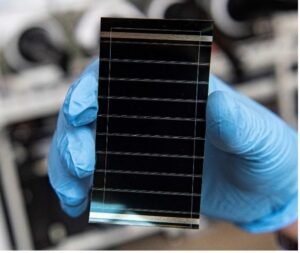
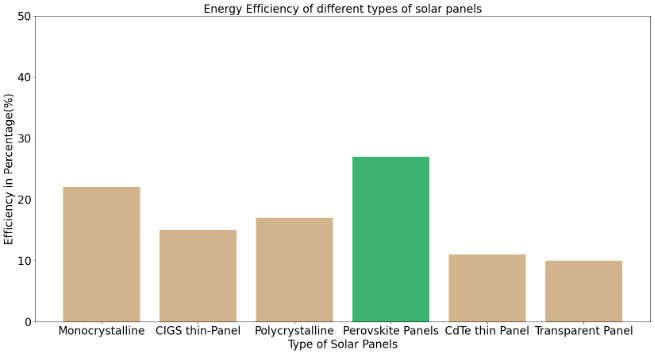
These new 72-cell modules reach almost 27% efficiency, beating most commercial solar panels by a solid margin. They can generate up to 20% more energy in the same amount of space, helping bring down the cost per watt and make solar more accessible for everyone.
Built in Germany and designed for ground-mounted, large-scale systems, these modules achieved energy efficiency from 3.8% to 20.2% with only 5 years of research. This trend of increase in solar power efficiency is bound to continue for the years to come, and it raises an important concern that comes with the mass production of solar panels. The cumulative waste produced by solar panels exceeds more than the weight-to-power ratio of solar cells, or in other words, they have shorter life spans with recycling challenges than their silicon counterparts. However, daily breakthroughs in materials engineering to create new hybrid materials are being published and researched more than ever.
Built in Germany and designed for ground-mounted, large-scale systems, these modules achieved energy efficiency from 3.8% to 20.2% with only 5 years of research. This trend of increase in solar power efficiency is bound to continue for the years to come, and it raises an important concern that comes with the mass production of solar panels. The cumulative waste produced by solar panels exceeds more than the weight-to-power ratio of solar cells, or in other words, they have shorter life spans with recycling challenges than their silicon counterparts. However, daily breakthroughs in materials engineering to create new hybrid materials are being published and researched more than ever.
3. Gravity Energy Storage – Turning Elevation into Electricity
Type of Energy: Gravity Storage Developed; by Energy Vault
Imagine if we could store energy by simply lifting and lowering giant blocks? That’s not a sci-fi concept—it’s what’s happening at Energy Vault, whose EVx™ Gravity Storage System uses custom-made composite blocks and cranes to harness the power of gravity. Like hydroelectric dams, this system also uses the same principle of converting gravitational potential energy to electricity.
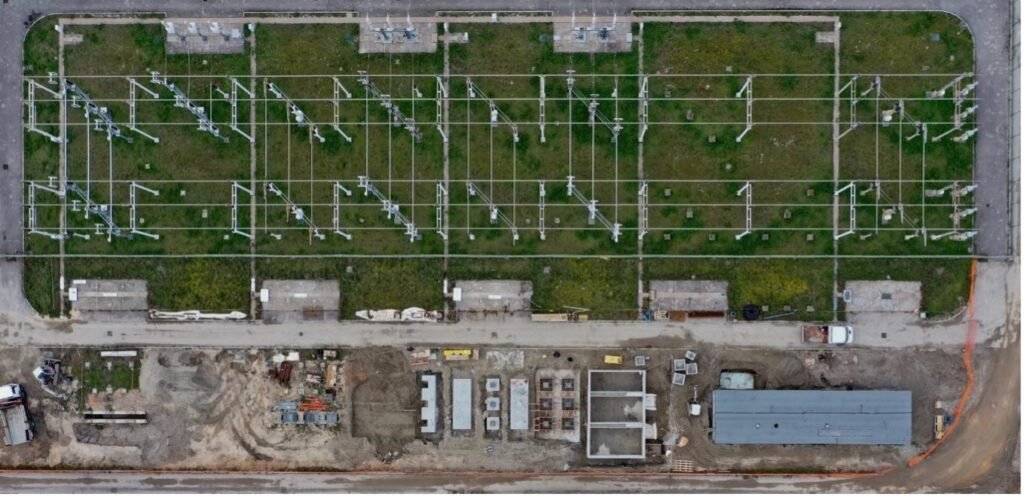
Here’s how it works: when there’s excess energy from wind or solar energy, the system lifts heavy blocks and gains potential energy. Later, when demand rises, those blocks are lowered, converting gravitational potential into electricity. When the blocks descend, the kinetic energy is converted to electric energy on the trip back. It’s simple, and surprisingly efficient, with round-trip efficiency over 80% compared to lithium-ion batteries. Moreover, these blocks can be made from waste materials, including decommissioned wind turbine blades, concrete, or recycled composites, hence promoting a circular economy.
We have all come across power grids that power entire cities. To give you a perspective, traditional power grids in the US have an efficiency of 40%, and a global carbon emission of 6342 million metric tons in 2022. However, this innovation of “gravity batteries” is the start of hydroelectric power plants without the need for an external watercourse, with an efficiency of 70%. The materials required have limited environmental impacts and requires very few rare earth materials. A thermal system using gravity storages would have GHG (Greenhouse Gas) emissions of 0.1250.45 metric tons per year. All of this applies circular economy principles that will eventually help us transition to a sustainable economic model, implying there is hope in the form of gravity at the end of the tunnel!
4. Direct Air Capture – Cleaning Carbon Straight from the Sky
Type of Energy: Carbon Capture & Storage Pioneered; by Climeworks (Iceland)
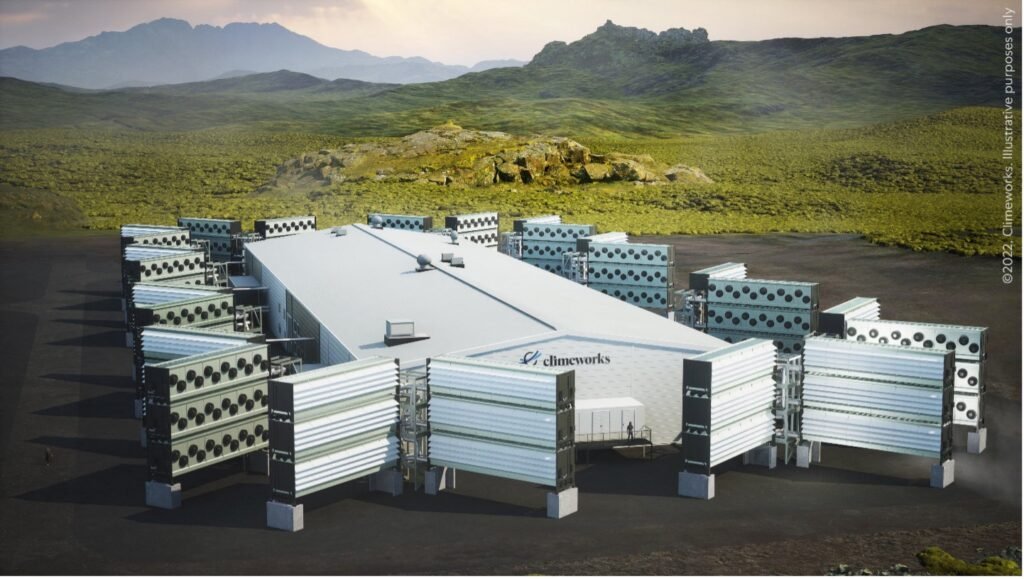
We talk a lot about reducing carbon emissions—but what about removing the CO₂ that’s already there? That’s exactly what Climeworks is doing in Iceland with Mammoth, the world’s largest direct air capture (DAC) plant.
Using modular collector containers, Mammoth captures up to 36,000 tons of CO₂ or equivalent to the emission from 8000 cars each year straight from ambient air. The carbon is then mineralized and stored underground in partnership with Carbfix, turning it into rock. Edmonton, Canada is also home to some of the world’s most advanced carbon capture and storage (CCS) facilities, including the Alberta Carbon Trunk Line (ACTL) and the Shell Quest CCS project, which have already prevented millions of tons of CO₂ from entering the atmosphere. And at the University of Alberta, researchers are pushing boundaries in carbon utilization, developing ways to turn captured CO₂ into useful products like fuels, building materials, and even sustainable plastics.
Climeworks aims to scale this technology to megaton levels by 2030 and gigaton removal capacity by 2050, making DAC a vital piece of the global climate puzzle. While DAC won’t replace the need to cut emissions at the source, it’s a powerful retroactive climate action for balancing the carbon budget and cleaning up our planetary mess.
5. From Coal to Clean Energy: Hybrid Storage System in a Repurposed Mine
Type of Energy: Hybrid Gravity + Battery Storage Project: Miniera d’Energia; by Energy Vault (Sardinia, Italy)

In Sardinia, Italy, the former Nuraxi Figus coal mine is being redefined as Miniera d’Energia, a hybrid energy storage facility by Energy Vault. By integrating gravity-based storage where massive blocks are lifted and lowered within 500-meter shafts with lithium-ion batteries, the project aims to balance long- and short-duration energy needs. Its completion by 2028 will mark a shift from fossil-based operations to renewable integration, using existing infrastructure instead of new land development.
What stands out about this initiative is its practicality as rather than relying solely on new technologies, it applies proven engineering within an existing framework. If successful, Miniera d’Energia could serve as a replicable model for converting decommissioned industrial sites into productive, low-carbon assets.
Each of these breakthroughs demonstrates a deliberate shift toward efficiency, adaptability, and environmental responsibility. Among them, perovskite solar technology stands out as the most immediately scalable, offering high efficiency and fusion remains the long-term goal, promising unparalleled energy density once technical challenges are resolved. Collectively, these innovations signal that the world’s energy future will be defined not by a single source, but by a balanced ecosystem of complementary technologies.